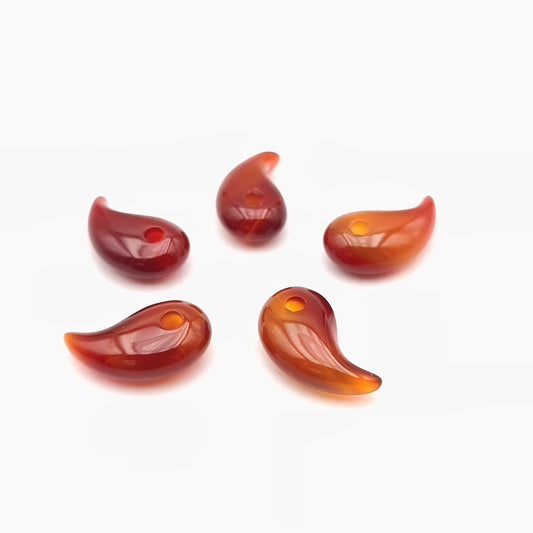
Natural Carnelian Wholesale – Supplier for Professionals
Minéraux d’Ailleurs offers a carefully selected range of natural Carnelian for wholesale to professionals. Valued since antiquity for its warm hues ranging from bright orange to deep red, Carnelian appeals to jewelry designers, specialty mineral shops, crystal healing practitioners, decorators, and passionate mineral collectors alike.
This natural stone has an instantly recognizable appearance. Its vibrant, sometimes translucent color creates a sense of warmth, dynamism, and energy that makes it particularly attractive in retail. In the jewelry industry, it is highly prized for making bracelets, pendants, beads, or cabochons. In the mineral and wellness sector, it is also sought after for tumbled stones, energy objects, and decorative pieces.
Thanks to its good hardness and stable mineral structure, Carnelian is suitable for many professional uses. It is easy to work with, durable, and retains its color well when properly cared for. These qualities make it an essential stone for enriching any natural stone product range.
As a specialist mineral supplier, Minéraux d’Ailleurs selects natural Carnelian from reputable deposits. Our goal is to offer professionals consistent quality suitable for resale, artisanal creation, and energy practices, while ensuring traceability and responsible sourcing.
What Is Carnelian?
Carnelian is a variety of chalcedony, which itself belongs to the larger family of microcrystalline quartz. This natural stone is composed mainly of silicon dioxide (SiO2). Its extremely fine crystalline structure gives it a homogeneous and often slightly translucent appearance, which is particularly appreciated in stonework and jewelry making.
Carnelian’s characteristic color comes from the presence of iron oxides in its structure. These natural inclusions give the stone its orange, red, or reddish-brown shades. Depending on the concentration of these oxides and the geological conditions of formation, the hue can vary considerably, from a light, almost honey-colored orange to an intense red close to brick red.
On the Mohs scale, Carnelian has a hardness between 6.5 and 7. This resistance makes it particularly suitable for everyday use, especially in jewelry. Carnelian beads and cabochons generally retain their polished surface well, which explains its popularity in creating durable jewelry.
Historically, Carnelian has been used for thousands of years. Sculpted objects made from this stone can be found in many ancient civilizations, notably in Egypt, Mesopotamia, and the Roman Empire. It was often used to make seals, amulets, or jewelry because it is easy to engrave and its color is symbolically associated with vitality.
Even today, Carnelian remains a highly valued stone in the fields of mineralogy, jewelry making, and traditional energy practices.
Visual Characteristics and Mineralogical Properties
Carnelian is immediately distinguished by its palette of warm, luminous colors. The most common shades range from bright orange and brownish-orange to deep red. Some stones also feature lighter, slightly whitish or translucent areas that create subtle visual effects when polished.
Its texture is generally homogeneous and compact. Unlike some other varieties of chalcedony that feature distinct bands or patterns, Carnelian often has a uniform appearance, making it particularly attractive when cut into a cabochon or bead.
Carnelian’s transparency varies from specimen to specimen. Some stones are almost opaque, while others become slightly translucent when exposed to light. This property gives Carnelian jewelry an interesting visual depth, especially in high-quality beads.
From a mineralogical perspective, Carnelian belongs to the trigonal crystal system characteristic of quartz. Its microcrystalline structure means that the individual crystals are extremely small and interlocked, forming a compact mass. This particularity explains its strength and its ability to be polished to a very smooth finish.
Some Carnelian stones also feature natural inclusions or slight color variations. These nuances reflect the stone’s natural character and often contribute to its aesthetic appeal. For professionals, these variations allow for a range of different qualities and styles, from soft, translucent tones to highly sought-after deep reds.
Finally, Carnelian has excellent polishing properties. Once worked, its surface becomes shiny and smooth to the touch, enhancing its appeal in artisanal creations and decorative objects.
Origin and Geology of Carnelian
Carnelian forms through complex geological processes involving the circulation of silica-rich solutions through rocks. Over time, these solutions penetrate cavities or fissures in volcanic or sedimentary rocks. As they gradually solidify, they form masses of chalcedony that can then become colored by iron oxides.
These oxides are responsible for the orange and red shades that characterize Carnelian. Coloration can occur naturally during the stone’s formation, but it can also develop over time due to heat and surrounding geological conditions.
The main Carnelian deposits are found in several regions around the world. India is historically one of the best-known producers, particularly in the Gujarat region. Indian Carnelian is renowned for its warm, deep colors and is highly prized for bead making.
Brazil is also a major producer of Carnelian. Brazilian deposits provide a wide variety of stones used for both cabochon cutting and the production of tumbled stones or decorative objects.
Other significant deposits exist in Uruguay, Russia, Madagascar, and certain regions of North Africa. Each geological origin can produce Carnelian with slightly different hues, enriching the diversity of stones available on the market.
Carnelian is often found associated with agate formations or other varieties of chalcedony in volcanic cavities called geodes. These environments allow for the gradual growth of silica-rich mineral layers, forming nodules that are then extracted and cut.
Available Shapes and Professional Uses
Thanks to its durability and ease of working, Carnelian can be shaped in many ways to meet professional needs. This variety allows shops and designers to offer a wide range of products made from this natural stone.
In the jewelry industry, Carnelian is particularly used in the form of round, faceted, or teardrop-shaped beads. These beads are highly prized for creating bracelets, necklaces, or earrings. Carnelian cabochons also make an ideal base for artisanal rings and pendants.
Strands of Carnelian beads are highly sought after by jewelry designers who wish to create their own collections. Color consistency and polishing quality play an important role in the final appearance of the creations.
In specialty mineral and wellness shops, Carnelian is often offered as tumbled stones. These polished stones are easy to handle and suit both collectors and people interested in energy practices.
Carnelian is also available as decorative or energy objects, such as spheres, pyramids, hearts, or sculptures. These pieces are highly valued for their aesthetic appeal and warm color, which easily catches the eye in a shop window.
Raw Carnelian specimens, meanwhile, appeal to mineralogy enthusiasts. They allow you to observe the stone in its natural state, sometimes associated with other chalcedony formations in nodules or geodes.
For professionals, this variety of shapes makes it possible to cater to different types of customers: jewelry lovers, natural stone enthusiasts, crystal healing practitioners, or simply decorative object collectors.
Carnelian in Traditions and Crystal Healing
Since antiquity, Carnelian has held an important place in many cultural traditions. Its warm, intense color has often been associated with vitality, inner strength, and the energy of life. In several ancient civilizations, it was worn as a talisman or protective amulet.
In ancient Egypt, Carnelian was considered a stone associated with vitality and protection. It was frequently used in funerary jewelry and amulets intended to accompany the deceased.
In some spiritual traditions, Carnelian is also associated with dynamism and self-expression. Its color often evokes energy, motivation, and creative drive.
In modern crystal healing, Carnelian is often associated with vitality, courage, and self-confidence. Some practitioners believe it can support people through periods of change or boost personal motivation.
It is also sometimes linked to creativity and artistic expression. For this reason, some people choose to keep Carnelian close when working on creative projects or seeking to stimulate their inspiration.
As with all practices involving natural stones, these interpretations are based on cultural and spiritual traditions rather than scientific evidence. Nevertheless, they contribute to Carnelian’s symbolic and cultural appeal in many specialty shops.
Why Offer Carnelian in Your Shop?
Carnelian is one of the most popular natural stones in specialty mineral, artisanal jewelry, and wellness shops. Its warm color immediately catches customers’ attention and stands out easily in a shop window or on a display.
Its affordability is also a major commercial advantage. Carnelian is available in different qualities and sizes, allowing you to offer products across several price points. From affordable tumbled stones to more elaborate decorative pieces, it can appeal to a wide audience.
For jewelry designers, Carnelian offers excellent aesthetic potential. Its color pairs easily with many metals, such as silver or gold, as well as other materials used in artisanal jewelry making.
Crystal healing shops also appreciate Carnelian for its positive symbolism, often associated with energy and motivation. It is one of the stones most frequently requested by customers discovering the world of minerals.
In home décor, Carnelian objects add a warm, natural touch. Spheres, sculptures, or decorative tumbled stones can easily fit into a variety of interior styles.
This versatility explains why Carnelian remains an essential stone in the product range of many specialty shops.
Your Carnelian Supplier for Professionals
Minéraux d’Ailleurs supports professionals in sourcing natural Carnelian with a carefully selected range of stones from reputable deposits. Our goal is to offer reliable, attractive products that meet the requirements of specialty shops.
Each batch of Carnelian is selected for the quality of its color, polish, and consistency. We also make sure to offer a variety of sizes and shapes to meet the diverse needs of jewelers, designers, practitioners, and resellers.
Our wholesale business allows us to offer pricing suitable for bulk purchases. Professionals can thus build their inventory with consistent quality while benefiting from advantageous purchasing terms.
We also place great importance on traceability and our relationships with our supplier partners. This approach helps ensure greater transparency regarding the origin of the stones and their extraction conditions.
Finally, our team is available to help professionals make the right choices. Whether you are looking for strands of beads for jewelry making, tumbled stones for resale in your shop, or decorative Carnelian pieces, we can guide you to the products best suited to your business.
Learn More
Crystal healing information is based on tradition and does not constitute medical advice.
Discover our Carnelian bead strands and bracelets: